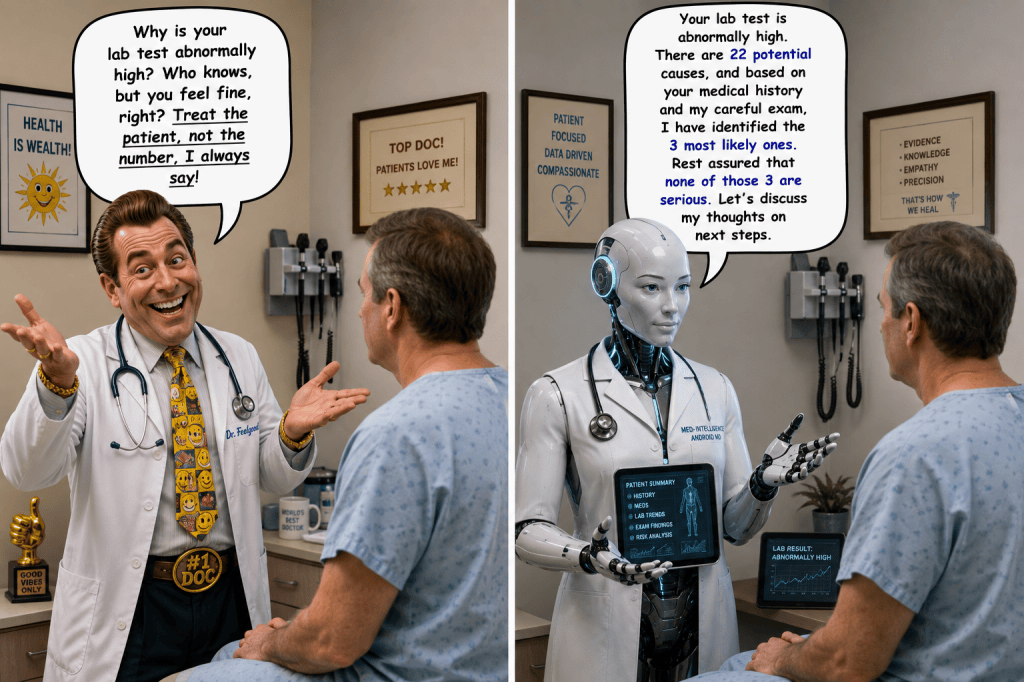
by Jonathan A. Handler, MD, FACEP, FAMIA
My last blog post was “(Mis)Leading by Pithiness: Three Laws of Aphorisms,” and I think the concepts there apply also to medicine. The stakes seem even higher in medical care, so if leading by aphorism can be fraught, making medical decisions by aphorism seems potentially even moreso.
If you haven’t read my previous post on pithiness, it’s not necessary, but it does strengthen the foundation for this post.
As I did in the earlier post, I should state my term definitions, specifying the difference between a medical aphorism (“aphorism”), a medical “pearl” (a tidbit of medical knowledge passed from one clinician to another that usually proves useful), and a medical “fact” (something that has been proven or is widely accepted as “true”). The likelihood that the statement will prove true or useful, without requiring additional wisdom and expertise to know when to apply it, defines whether it is an aphorism, pearl, or fact, with each listed in increasing likelihood that it will prove true or useful. Here is what I might consider an example of each (brackets are my edits for clarity):
- Aphorism: The patient is not a textbook (i.e., the patient’s condition may not always show the typical signs and symptoms).
- Clinical pearl: “Generalized pruritus [itching all over] in a long-time diabetic with no clear explanation warrants kidney function tests” or “Painless hematuria [blood in the urine] in 50-year-old [and over] male is bladder carcinoma unless proven otherwise.”
- Medical fact: Clindamycin (an antibiotic) “has virtually no activity against aerobic gram-negative bacteria.”
NOTE: Nothing in this post should be construed as medical advice.
The problem with aphorisms (as opposed to pearls and facts) is that, virtually always, there is (or could be) an opposite and equally “wise” sounding version of it. If you can take a phrase intended to provide clinical guidance and offer an opposite and equally correct and wise-sounding phrase, you are probably dealing in aphorisms.
Often, the greatest challenge for a clinician is making a diagnosis. We have many aphorisms around that, frequently related to diagnosing common vs. rare conditions. For example:
- Common
- When you hear hoofbeats, think horses, not zebras.
- If it looks like a duck and quacks like a duck, it’s probably a duck.
- Common things are common.
- Uncommon
- Always maintain a high index of suspicion for [uncommon medical condition].
- The eyes do not see what the mind does not know.
- All that wheezes is not asthma.
- The patient is not a textbook.
We have many more “competing” aphorisms, here are just a couple.
- “Treat the patient, not the number” vs. “Vital signs are called ‘vital’ for a reason.”
- “Trust your gut” or “Medicine is as much art as science” vs. “Follow the data”.
I believe medical aphorisms (as I have defined them) are useless, because knowing which one to use in any particular clinical context requires wisdom and experience. Those who already have wisdom and experience don’t need the aphorism — they already know it and when to apply it. Those who don’t have the wisdom and experience don’t get value from the aphorism because they don’t know when to apply it. Worse, if the inexperienced do apply an aphorism and it “works,” it seems more likely due to luck than skill. However, they may think they have learned an important lesson. If they now apply it blindly, they may be as likely to cause harm as to help.
Perhaps more interestingly, with modern medical care, the probability of correctness of these aphorisms has likely evolved. In the old days, making a rare diagnosis often required performing an invasive procedure. Once the diagnosis was made, it often couldn’t be effectively treated, or could only be treated with an invasive procedure. If you “chased down” the cause of an abnormal lab test, there was a decent chance you would cause more harm than good, and/or risk harm to uncover a diagnosis you couldn’t treat anyway.
Nowadays, many things are different. We have high-resolution and even dynamic imaging (CT, MRI, ultrasound). We have more advanced blood tests and even genetic testing. We also have a host of less invasive therapies and medications to better treat diseases that used to be untreatable. Everything has risks, but the risks of these less invasive diagnostics and therapeutics are often much lower than the invasive ones they replaced. And the probability that we can effectively treat what we find is generally much higher today than it was in the past. So, the likelihood that “treat the patient, not the number” is more often the right thing to do seems to be rapidly diminishing.
There are many “silent” diseases that we now know are deadly if not treated early. Should we stop treating asymptomatic hypertension and diabetes since the patient feels fine and these are “just numbers”? Should we allow those patients to progress to permanent end-organ damage and death? If a patient is found on ECG and blood testing to be having a “silent” heart attack, should we ignore it and send them home so that we are “treating the patient and not the tests?”
The likelihood that the best approach is to always assume that “common things are common” also seems to be rapidly diminishing. Should we assume that every patient who comes to the emergency department with “atypical” chest pain probably has a sore rib or some other benign condition and always just send the patient home immediately with no further testing because, collectively, those benign conditions seem generally considered more common than a heart attack? Maybe that’s what they did back in the “good ol’ days,” but nowadays we know that lots of people will likely unnecessarily suffer or die with that plan of action. (see Appendix below for more on this)
In our modern world of super-short appointment times for ever-sicker and more complex patients, clinicians may fall back on time-honored aphorisms to facilitate their decision-making. But medical care evolves, and the aphorisms that were useful in 1590s, 1950s, or 1990s may be less useful today. Some may even prove dangerous. For virtually every anecdote supporting an aphorism, many others seem to refute it. Generally, the answer to inadequate data needed to support good clinical decision-making is not to lean on aphorisms, it’s to gather better data. While that often means doing more testing, perhaps even more often that means taking a more careful history, doing a more thorough physical exam, reviewing the chart more completely, and consulting experts and relevant textbooks and research. Our grand challenge in medicine is that clinicians commonly aren’t given (or won’t take) that time, but achieving great care requires it. I believe aphorisms cannot compensate for poor history taking, perfunctory physical examinations, cursory chart reviews, or weak clinical decision-making. In fact, relying on aphorisms in those cases often seems to make a bad situation even worse.
You know who I predict won’t use an aphorism to replace a truly thorough and thoughtful history-taking, a meticulous physical exam, and a deeply considered analysis of every drop of available data to come up with a diagnostic and therapeutic plan? An AI-powered robot. AI is here and I predict AI-powered robots are coming soon. Does that sound that ridiculous? If providing the best care is paramount, then I hope not, because most primary care doctors reportedly feel they are shortchanging patients due to lack of time. As a doctor, that scares me. As a patient, that scares me even more. That survey also found the doctors have significant distrust of AI. However, AI continues to evolve and things will change. Even though patients deserve better than overly short, aphorism-driven care, too many have had no real alternatives. If patients ever perceive (and especially if rigorous studies prove) that AI will give them the time and expertise they need, then we doctors may be toast. This is the opportunity to preempt that threat, and perhaps I can describe how that might be done with an aphorism I just made up 😀(with apologies to The Sphinx from the movie “Mystery Men”): When the doctor doesn’t rush through patient visits and keeps “a eye” on earning the patients’ trust, then the patients will rush to visit the doctor they trust instead of turning to AI for their healthcare needs.
Appendix:
Someone reading this at some point will probably object that some of this thinking might lead to spiraling healthcare costs. However, that goes beyond strictly medical considerations (if there even is such a thing) and into holistic decision-making. If it’s weighing the patient’s financial health against their physical health, that decision probably belongs to the patient. If it’s weighing the country’s financial health against its physical health, that decision probably belongs to society. Too often, it appears that clinicians make treatment decisions for an individual patient based on assumptions about what’s financially reasonable for society, as if that’s an established fact rather than an opinion or guess. Even though there are various stated values for a “reasonable” cost per year of life saved, or quality-adjusted cost per year of life saved, it seems almost no one bothers to use those to do even a simple “back-of-the-napkin” calculation to estimate what threshold for further care is financially “reasonable” from a societal point of view. And I haven’t seen that clinicians routinely incorporate the financial implications of their medical opinions in decision-making with patients, except when the decision is associated with a well-known, and extremely high, potentially out-of-pocket cost. In any event, a phrase that is almost always correct or useful in most clinical contexts that takes into account what’s right medically for the patient, financially for the patient, and financially for society would not be an aphorism. It would be, by my definition, a pearl or a fact.
All opinions expressed here are entirely those of the author(s) and do not necessarily represent the opinions or positions of their employers (if any), affiliates (if any), or anyone else. The author(s) reserve the right to change his/her/their minds at any time. Nothing here should be construed as medical advice.


Leave a Reply