by Jonathan A. Handler, MD, FACEP, FAMIA
The Problem
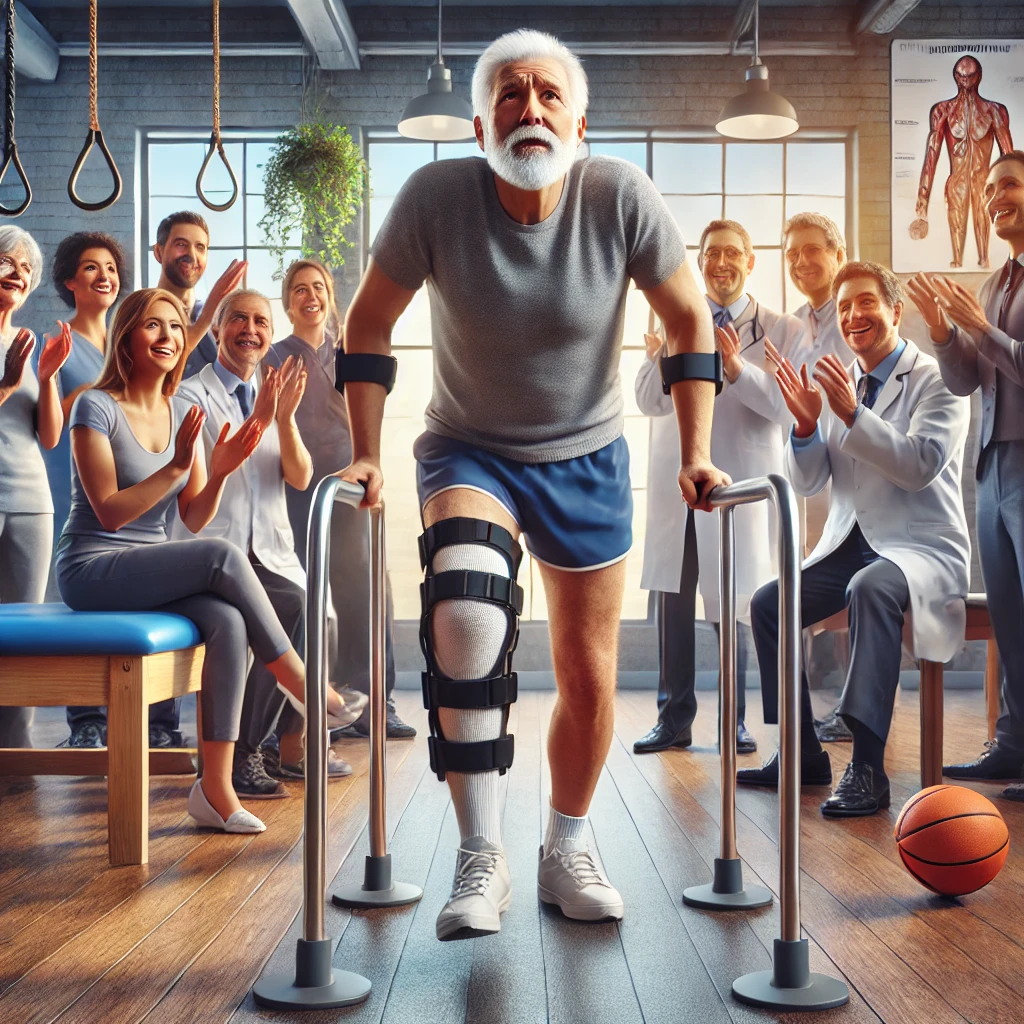
Have you ever seen the following in a movie or TV show? Someone has had a tragic accident or medical event and needs to undergo physical therapy to get better, but they feel hopeless and reluctant. Then a dedicated person or team of doctors, nurses, therapists, family members, and/or friends enthusiastically and persistently offers encouragement. The patient responds with heroic effort and succeeds! This is a trope that I have seen and found inspiring.
So, my hopes were high when someone I know (let’s call him “Y”) ended up in a skilled nursing facility for rehab. After a fall with a significant fracture, rehab was just what the doctor ordered! In fact, it is exactly what the doctor ordered. Imagine my shock and dismay when I discovered that therapy was only once or twice a day, for 20-30 minutes at a time. For the rest of the day, Y generally just lay in bed. The family had to fuss to get the staff to get him out of bed. On the weekends, there was little to no therapy, so Y did virtually nothing for those two days. And if Y wasn’t in the mood, the therapists often seemed happy to move on to the next patient. This was nothing like the movies! Instead of getting stronger and rehabbing up, Y weakened and de-conditioned down. He was far less active than he would have been had he just gone home with a 24-hour caregiver and no therapy. It seemed literally the opposite of rehab, and it stayed that way until his family hired a private caregiver using their own money. The private caregiver would get him out of bed, do exercises in-between the brief physical therapy sessions, and interact with him when his family and friends couldn’t be there.
It seems as if many people I know tell me their similar stories, shocked at the lack of rehab their loved ones received during rehab.
One night, while in the same facility but this time for long-term nursing care, Y awoke and had to go to the bathroom. He hollered for help over and over, but no one came. The staff member on duty was with another patient and heard Y calling but felt uncomfortable leaving the patient to attend to Y. Unfortunately, that staff member didn’t call another staff member to help. So, Y managed to get hold of his walker, get himself out of bed (who knew he could do that? — that’s the power of motivation), and get himself to the bathroom. When he got to the bathroom, he fell on the hard floor and sustained multiple fractures and at least one other internal injury. The response time, even after the fall and injuries, was far longer than it seems anyone thought appropriate. The injuries required hospitalization and caused him significant pain and suffering.
It seems like around-the-clock, one-on-one staffing for everyone who needs it, whether at home or in a long-term care facility, would be optimal. Without it, a situation could arise in which there aren’t enough staff to respond to patients in need. However, I doubt most people have insurance that covers continuous 1-on-1 long-term nursing care, and I suspect very few can afford to pay for that out of pocket. So, most facilities presumably can’t provide that care without going bankrupt. Even if facilities could afford it, I imagine it’s challenging to find and retain staff with the training, physical strength, and health needed to safely help someone ambulate. This seems especially likely given that nursing home staffing shortages have been reported and are anticipated to worsen.
The Scope of the Problem and the Market Opportunity
It seems many people I know had to move a relative out of their home and into long-term care, hire and manage caregivers, and/or quit their jobs to serve as a caregiver because the relative could no longer safely get around the house without help. In virtually all cases, the spouse (if any) was unable to safely assist. And… the stresses and costs we have today related to elder care seem on track to substantially increase, because the US is trending toward an older population, with about a 30% increase expected over the next 30 years in the number of people over age 65.
How will we afford all these caregivers and nursing homes? How can we make a better experience for our population as we age? How can we avoid bankrupting the country with elder care that makes too few people happier and healthier?
Solutions exist to help address this problem, such as hip protectors (some act like an airbag in a belt, protecting the hips in a fall) and compliant flooring. Studies have found potentially promising but early and sometimes inconsistent results (see here and here). However, the solutions are not perfect, many having challenges that may include high cost, poor patient acceptability and/or compliance, inability to protect all body parts, and/or challenges with use in baths and showers.
The Innovation (I think) We Need
With all this in mind, I propose that a single technology may take us a long way to addressing the challenge of elder care: a robotic companion that will do just three things with the person in their care: 1) stay with them at all times, 2) catch them if they start to fall, and 3) help them safely transfer to and from standing, sitting, and lying.
Is This Realistic?
Is this realistic in a reasonable timeframe? I think it might be! Robots have reportedly demonstrated abilities to walk, climb stairs, jump, stay upright under very challenging circumstances, dance and balance on one foot, navigate crowded areas safely, and perform delicate maneuvers. If some of these capabilities can be combined to provide fall prevention and transfer assistance, we may find that millions can now live safely, independently, and at lower cost. Ensuring that the robot can catch someone who is falling, or assist them up and down without causing harm may require some ingenuity. For example, the person may need to wear a belt and suspenders with metal bars so that a robot with magnetic hands can safely and easily catch or assist them, just as a human might do (e.g., see here, here, and here [NOTE: I’m not endorsing any of the methods of assisting people in those links, just sharing examples of what some others recommend]).
Can we afford all these robots? At least one robot on the market reportedly sells for only $16K. That’s still a lot of money, but it’s far less than the $219K per year for around-the-clock caregivers at $25/hour.
Let’s say that our requirements for the android robot lead to an increased cost of $50K instead of $16K. Let’s assume that the robot has a 5-year lifespan, and we buy it with a 5-year loan at 6% interest. That would amount to less than $12K per year, far less than $219K per year for a caregiver performing only those same tasks. Toss in a modern-day, LLM-based chatbot’s abilities, and we might find robots can provide both greater safety and more consistent interaction at a fraction of today’s costs. If the androids are as successful as we might hope, a long-term care facility offering one android per patient might find benefits such as greater patient satisfaction and safety, greater staff satisfaction and retention, fewer lawsuits, lower insurance costs, and greater profitability and sustainability. Better yet, many people may be able to “age in place,” with the androids enabling them to stay in their homes with their loved ones, enjoying independent living.
Getting to Success
The current state of technology might be advanced enough to achieve this in the next few years. However, the regulatory, legal, and societal environment trio might not be. We need this trio to protect the public, and at the same time, the trio at times seems to value preventing harms of commission (harms caused by the technology) over preventing harms of omission (harms caused by not having the technology). For example, let’s say the net effect of putting 100 robots out in the marketplace is 10 lives saved over a 5-year period. I say “net effect” because imagine that the robots prevented 11 falls with injury but caused one injury by, let’s say, catching someone too aggressively. One could imagine that this harm of commission (the injury caused by the technology) could lead to a lawsuit, costly investigations, negative PR, and/or regulatory penalties, perhaps leading the robotics company to go out of business. Now, had the company never put the robots on the market, the 1 person would be uninjured, 11 more would be injured, and there would be no lawsuits, no penalties, no negative PR, and no costly investigations. One might argue in this scenario that the robots would create a strong net benefit (if all injuries were similar), but without some form of indemnification, the risks and costs may be too great for anyone to pursue that business. Or, maybe companies will pursue the business, but the regulatory overhead may delay the introduction of the solution for years and increase the costs dramatically, so that only the wealthiest can afford it — the very same people who may already have an ability to afford round-the-clock human caregivers.
Of course, we need checks and balances. What if that one person was injured due to gross negligence on the part of the robot manufacturer, and the injury would have easily been prevented with a simple fix to a known bug in the robot’s software? What if it turns out that the robot causes 2 falls for every 1 it prevents? Regulations, laws, and societal expectations exist to protect us from these things, and they need to strike the right balance between protecting us from harm and ensuring we benefit from healthcare innovations. That can’t be easy.
However, we may be able to find solutions. For example, in the US, we addressed a seemingly similar issue with vaccines. The VICP fund compensates people injured by vaccines covered under the program, serving as “a no-fault alternative to the traditional tort system,” Without it, concerns of lawsuits against the manufacturers of vaccines, and even against healthcare providers, threatened the availability of vaccinations for the public. As another example, the FDA’s Emergency Use Authorization program enabled safe and effective COVID-19 therapeutics, vaccines, and diagnostics (like the omnipresent nasal swab tests) to rapidly get on market. The US government has moved quickly, safely, and effectively when needed. Perhaps they can get the same outcome for elder care. As was the case with vaccines, COVID-19 tests, and even facilitating widespread adoption of EHRs, some form of governmental involvement may prove integral to achieving success quickly, safely, and effectively.
Naysayers will point out many other needs of some older adults, especially among those with dementia, including assistance with: medication administration, eating and drinking, food preparation, vital sign checks, travel to healthcare appointments, and more. However, I propose “preventing falls and facilitating transfers” as the biggest need over those other things specifically because most people don’t need round-the-clock care just for those other tasks (e.g., medication administration), but someone at high risk of falls or unable to safely transfer probably does. If robots with limited capabilities can only help tens or hundreds of thousands on Day One, instead of millions, that still seems like a big win. Finally, I see many of those other tasks as readily doable by a robot. Think that the androids can’t provide empathy? As noted in one of my earlier posts, the medical literature suggests maybe they can! If software updates lead to enhanced capabilities over time (just like I get with my electric car), we may see rapid growth in the fraction of the population that can benefit.
From what I’ve read and heard, it seems that many people, maybe most, don’t want robots replacing humans. If you are lucky enough to have humans who can meet the need, great! Too many others, though, have no human at all, or the human can’t be there in the time of greatest need, or the human lacks the training to do a great job, or the human (being human) is having a bad day and unable to give their best when their best is needed. Maybe this will move us toward a better outcome, where humans provide all the goodness, service, and humanity to older adults that they possibly can, and robots can do some or all of the rest.
All opinions expressed here are entirely those of the author(s) and do not necessarily represent the opinions or positions of their employers (if any), affiliates (if any), or anyone else. The author(s) reserve the right to change his/her/their minds at any time.
 Zero Effectors
Leave a comment